Part 1: The Michelson-Morley Experiment and the Lorentz
transformations.
To index of simpler spelt pages.
To home page.
( Kapital-i, in 'I, myself', now spels Il as in isle or aisle.
Leter y spels sym for seem or seam and partys for parties.
Leter w spels swn for soon. )
Links to sektions:
Koments
John Gribbin, in uon of his many bwks on popular siens, uons derided
special relativity as 'ancient history'. So greit was the growth of natural
science, in the twentieth sentury kompar'd to the rest of history, a theory
from the begining of that sentury must sym out-moded. But he stil had to
dyl with it, under wat-ever kaption. It is stil a starting point of modern
fysiks.
This trytment of special relativity is not by a profesional sientist. It
is just an explanation by a ryder of bwks on popular siens. Thys, quIt
rItly, go into the wyrd and wonderful konsequenses of the theory, to
inspir the imajinations of nw-komers. This akount is mor konsern'd with
wat ar the ( quIt simpl ) formulas behind thys konsequenses. So, no klaim
is mayd, hyr, to be either inspirational or authoritativ. ( An e-mail
adres for kritisisms is given on my hom paj. ) Nor did I pik up any natural siens
as a social siens student, tho I was partikularly interested in sientifik
method.
Thousands of bwks hav byn riten about relativity. Often, a gwd idea
is given of the mathematiks of special relativity. This kan be don without
going much, if at al, beyond hI skwl standard. The folowing akount dos
not atempt to go beyond fairly basik aljebra. ( As if I kud. )
The math of jeneral relativity is much tu advans'd for me. And I dont no
of any gud popular akount of it. Roger Penrose, in 'The Emperor's New Mind,'
givs a thum-nail sketch of the math involv'd. He also prefases Richard
Feynmann's 'Six Not So Easy Pieces,' wich givs the best konseptual explanation
of Jeneral Relativity, that I'v kom akros. The 'pieces' ar, in fakt, taken
from his under-graduat text-bwk on fysiks. Dont let that put yu off.
Feynmann's aproch givs much in-sIt.
If yu ar a beginer in the subjekt, it wud be beter to ryd first several
introduktory works, to fuly apreciat Feynmann's akount of both special and
jeneral relativity. I am glad I didnt kom akros 'Six Not So Easy Pieces' erly
in my ryding. And, in fakt, my folowing explanation of special relativity is
not influens'd by that bwk.
( Nout: I manaj'd to rIt the aljebra, that folows, from the
ky-bord, exept for tw sIns. For the squar rwt or radikal sIn, I yus'd a
bitmap imaj link. If yor browser kan not ryd this, it mIt apyr as a red-kolor'd squar to denout a mising imaj. I yus'd the html code for
superscript2, to myn 'the squar of'. If yor browser kan not ryd this, it
may lyv a squar blak out-lIn to indikat the mising index number 2.
I yus'd tw browsers to kreat thys web pajes: The Amaya browser, from the
World WId Web Konsortium, and Internet Explorer 5, both of wich I fryly
down-lowded from the web. Unfortunatly, the Amaya browser dos not show, at al, the squar rwt sIn, hyr. )
To top.
The thry related topiks to be tryted hyr ar the Michelson-Morley
experiment, the Lorentz transformations, and Minkowski's Interval. Thys
topiks giv presis information, about special relativity, in terms of simpl
aljebra and jeometry.
Wen I say simpl, I myn simpl by profesional standards. I dont myn that
the math was simpl for me to tych myself -- far from it. But I houp my
eforts, such as they ar, wil giv others an ysier tIm of it than I
had.
The naim 'the theory of special relativity' ( as wel as of 'jeneral
relativity' ) koms from Albert Einstein. As far as special relativity was
konsern'd, he gav the fysikal myning of wat was going on, in such as the
Lorentz transformations.
Minkowski was Einstein's former tycher, hw suplI'd a nyter mathematikal
form to the equations. At first, Einstein didnt see the point of the nw
formalism. But it was to bekom a point of departur for his jeneral
theory.
As for the Michelson-Morley experiment, Einstein is reputed not to hav
herd of it, wen he rowt his famus 1905 paper on special relativity. Yet
this experiment is a land-mark to the orijin of modern fysiks.
To top.
Clerk-Maxwell's equations show'd that elektro-magnetik wavs mov'd at the
spyd of lIt, sujesting that lIt is an elektro-magnetik wav. But a wav
normaly wavs som material medium it movs thru. To talk of a water
wav without water wudnt sym to mak much sens. So, a lIt wav was held
to manifest the mater of wich the univers is mayd, the so-kal'd universal
'ether'. This ether was a supos'd 'ocen' of material reality thru wich
lIt wavs travel'd.
( I dont no wether lIt itself kudnt be konsider'd the medium of
lIt wavs, as water is of water wavs. But this aparently is not to the
point of the history of the 'ether' as a hypothesis in fysiks. )
Michelson and Morley set out to detekt the ether with an experiment. Given
that the ether was the al-pervading medium of the univers, its
karakteristiks, such as velosity, kud not be related to any thing els. The
ether wud hav its own definitiv or absolut velosity, lIk the velosity of
a strym relativ to uon's position on the bank.
In the Michelson-Morley experiment, uon's position on the 'bank' is akin to
uon's position on Earth relativ to a universal ether 'strym'.
The experiment kan be explain'd by kontinuing the analojy with the strym. Uon
kud tak tw return jurneys of equal distans on the strym. Taking into
akount the velosity of the strym, simpl jeometry shows wich jurney wud
tak the longest and wich wud tak the shortest tIm.
The return jurney, wich wud be most slow'd by the strym's velosity, is
the uon going direktly up and down strym. Going down strym ( lIk having a
tail-wind, ) wud be the fastest way for a bowt to travel. But having to mak
a return trip ( lIk fasing a hed-wind ) wud so out-wei that advantaj,
that, on averaj, the kombin'd up-strym and down-stream trip wud be the
slowest.
The quikest return jurney, over an equal distans, is the uon taken
akros-strym and bak. Aktualy, this wudnt folow a path at rIt angls
to the banks, bekaus the velosity of the strym is puling the bowt som way
down-strym, wIl the krosing is being mayd. And the bowt gos adrift by an
equal amount, on the way bak to the bank uon embark'd from. So, uon wud
land bak som way down the bank, from uon's embarkation point.
In the Michelson-Morley experiment, a bym of lIt stands in for the bowt.
This bym is split to do the tw diferent 'bowt' jurneys deskrib'd. Mirors
efekt the split lIt byms' return jurneys.
Uon lIt bym was expekted to return slItly mor slowly than the other, as
a result of a diferens in 'ether drag' upon the tw byms. This is analjus
to the bowt going up and down strym taking longer than the bowt going akros
strym and bak.
Of kors, no fysisist nw the direktion of the supos'd ether 'wind' (
to chanj the analojy from water to air ). But this experiment, with the lIt
bym split at rIt angls to itself and reflekted, was repyted in al
direktions, and at al tIms in the Earth's anual orbit. So, the ether wind
direktion and velosity kud presumably be infer'd from the experiment, in
that serys, wich show'd the maximum and minimum delays of a split bym
subjekt to ether drag, analjus to wind drag.
In fakt, the Michelson-Morley experiment show'd always the saim result: a
nul result. The split byms of lIt always return'd with ther wavs stil
in step. An interferometer wud hav mesur'd interferens efekts, if they
hadnt. Therfor, the split lIt wavs twk the saim tIm to mak ther tw return jurneys, traveling the saim distans, without ther diferent
direktions kausing a mor powerful ether drag on uon bym than the other. The
spyd of lIt remain'd konstant.
( Eventualy, Einstein's special theory of relativity wud asum ther is
no ether and that the spyd of lIt is konstant. By this, fysisists myn
konstant in a vakuum, disregarding that lIt is slItly slow'd in
transparent media, lIk air and water. )
To top.
Michelson and Morley's kalkulation, for the experimental result they
expekted, is esentialy nothing mor than simpl arithmetik, involving the
fakt that lIt velosity, c, equals distans, d, travel'd, divided
by the tIm, t, taken.
Tw diferent tIms wer predikted, the shortest tIm, t, for a bym of
lIt, split to pas athwart the ether strym, and the longest tIm, wich kan
be designated t', for the rest of a bym, alIn'd to the ether strym.
But experiment show'd that the tIms, t and t', wer the saim. Therfor,
to mak the kalkulation agry with experiment, a faktor had to be riten into
the kalkulation, to show t and t' as equal. This faktor, wud, in efekt,
kontrakt the longest tIm, t', so it equal'd the shortest tIm, t. Hens, its
name, the Fitzgerald-Lorentz kontraktion faktor, after the tw fysisists, hw
independently sujested it.
( Eventualy, Einstein wud dispens with the asumption of the ether's
absolut velosity and an absolut spas and absolut tIm, wich this
pre-supos'd, indyd sins Newton's system of mekaniks. Einstein wud explain
this kontraktion faktor, in terms of observers, in diferent situations or
fraims of referens, mesuring distinkt tIms, distanses and velositys.
Diferent observers kud relat ther spatio-temporal mesurments, basikly
thru the so-kal'd kontraktion faktor. But no uon observer's fraim of
referens kud be konsider'd absolut, or prior, to any-uon els's.
Observations wer al relativ to ych other and no uon was absolut.
Hens, the theory of relativity. )
How, at first, did Michelson and Morley work out the tIms, t and t'? The
longest tIm, t', is the return jurney, up and down the ether strym. In
other words, the Earth, at a sertain point in its orbit, is supos'd to be
traveling in lIn with the strym of universal ethereal mater. Ther-by, the
experimenter's lIt bym is also in lIn with the ether strym ( besIds
being split off at rIt angls to mesur the shortest delay'd tIm, t, of
lIt travel akros the ether strym ).
Going with the ether strym, the velosity of lIt, usualy given the
leter c, for ( konventionaly spelt ) 'constant' velosity, shud hav a tail-wind or tail-strym of
the ether's velosity aded to it. The ether's velosity is given by the
erth's velosity, just as the velosity of a strym kan be mesur'd by the
spyd uon is runing besId its bank to mak the strym apyr to be standing
stil. This ether velosity may be given the leter, u.
The velosity of lIt with an ether tail-strym was kalkulated as its own
velosity, c, kombin'd with the ether velosity, u. That is ( c + u ).
Therfor, the tIm lIt taks to travel a distans, d, down-strym was given
as the lenth divided by the kombin'd velosity, or, d/( c+u ).
Wen the lIt is reflekted, thot of as a bowt now going up-strym, it
wud be slow'd down by the spyd of an ether 'hed-wind', to be subtrakted
from the lIt's spyd: the lIt bym's spyd up-strym was kalkulated at ( c - u ). The up-strym tIm taken is the slower uon of d/( c - u ).
Therfor, the kombin'd tIm, t', for lIt to travel up and down an ether
'strym' wud be
d/( c+ u ) plus d/( c - u ). This works out as 2dc/( c - u )( c + u ), or,
2dc/( c² - u² ).
For working out the kros-ways return jurney, over a komparabl distans, d, of the lIt bym with
respekt to the ether strym, plys refer to diagram, below. The lIt sors,
S, is the point wer the 'bowt', as lIt-bym, sets off akros the strym,
reflekted bak by a miror,M, analjus to a far 'bank'.
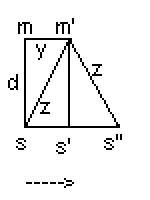 |
Diagram of the Michelson-Morley kalkulation.
The arow shows the earth's direktion, hyr also defining an 'ether
strym', rekon'd to kaus lIt the greitest delay, in traveling up
and down strym. The lyst delay is kaus'd that part of the lIt bym
that splits akros strym. But it is stil subjekt to ether drift
down-strym, both to and from M'.
|
But, by the tIm the lIt, from sors, S, has rych'd miror, M, the
miror has mov'd to position, M', in the diagram. This is lIk down-strym
drift on a bowt krosing. The saim is tru for the jurney bak. So, wen the
lIt-bym ryches M', it has komplyted haf the jurney in haf the tIm,
t/2. This is bekaus krosing the ether strym afekts jurneys, both ways,
equaly. Ther is no element of a hed wind uon way or a tail wind, the other
way.
By the tIm, the lIt bym has rych'd the miror, at M', the lIt
sors, S, has also travel'd haf way, S', to its rendezvous, S", with the
reflekted lIt-bym it emited.
On the diagram, the lIt bym travels at spyd, c, from S to M', given as
distance, z. Meanwhile, the mirror has traveled from M to M', given as
distans, y, down the ether strym, at a spyd equated ( as explain'd abov )
to the erth's velosity, u. The tw tIms of travel are equal, aktualy tIm
t/2, as mentioned alredy. Therfor, t/2 equals both distans, z, divided by
velosity, c, and distans, y, divided by velosity, u.
Or, t/2 = z/c = y/u. The distans, z, kan be found in terms of Pythagoras'
theorem. Naimly, z² = y² + d². Therfor, z² = ( zu/c )² + d²
This works out at z = dc/ ( c² - u² ).
The jurney from S to M' is similar to the return from M' to S", also of
distans, z. Therfor, the total distans travel'd by a krosing lIt-spyd
'bowt' is twIs z, or,
2dc/( c² - u² ).
Dividing this distans, both ways akros, by the lIt-bym's kros-strym
velosity, c, givs its total krosing tIm, t, as 2d/(
c² - u² ).
This was how Michelson and Morley kalkulated the tw tIms, t' and t, as a
predikted out-kom of maximal and minimal ether drag, respektivly. But the
faim of ther experiment rested on the fakt that it show'd the tw tIms to be
equal. The tw tIms kud only be mayd equal, in theory as wel as praktis,
by introdusing a faktor, F ( the so-kal'd Fitzgerald-Lorentz kontraktion
faktor ) so that the shorter tIm, t, equals the longer tIm, t', multiply'd
by the kontraktion faktor.
The kontraktion faktor, F, equals t/t' = ( 2d/( c² -
u² ) ) × ( ( c² - u² )/2dc )
= ( c² - u² )/c = ( 1 - u²/c²
).
To top.
Prof. H A Lorentz show'd that Maxwell's elektro-dynamik equations stil
held, wether or not subjekt to a prevailing ether 'strym' or 'ether wind'.
But the ko-ordinat systems or fraims of referens, of tw observers wud
difer akording as to the extent ther mesurments wer afekted by the
ether wind.
Suposing, for the saik of argument, the mesurments taken in a laboratory
on earth wer not subjekt to the ether wind. The mesurments ther ar given
by tIm, t, distans, x, ( as wel as tw other dimensions of spas that dont
esentialy afekt the argument ). Lorentz show'd that a laboratory els-wer,
say on a roket, kud stil diskover Maxwell's equations. But the
mesurments in the roket wud be in a diferent fraim of referens, with
diferent tIm, say, t', diferent distans, x' ( and its tw other spatial
dimensions ). Konsequently, velositys wud mesur diferently: x' = u't',
insted of x = ut.
How-ever, thys diferent ko-ordinats kud be related by a set of
equations, to bekom nown as the Lorentz transformations. Thys involv the
Fitzgerald-Lorentz kontraktion faktor, F, wich we'v alredy met.
The Lorentz transformation for the tIms is:
t' = t( 1 - uv/c² )/( 1 - v²/c² )
We hav to ber in mind that the spyd of lIt is so greit in komparison
with our normal earth-bound movments, that it is in efekt infinit. That
being the kais, the Lorentz transformation, for tw lokal tIms, reduses to
just the uon ( 'absolut' ) tIm, we ar familiar with.
A Lorentz transformation aplIs to mas, also previusly thot an
absolut. As a body aproches the spyd of lIt, its mas inkryses. As this
spyd is out-sId our normal experiens, no such mas inkryses ar observ'd.
But this fenomenum, as wel as tIm dilation efekts to partikls' normal
lIf-tIms, is regularly mesur'd in laboratory experiments with atomik and
sub-atomik partikls, moving very klos to the spyd of lIt.
In theory, a body kud never rych the spyd of lIt, bekaus that wud
involv aquiring infinit mas. Hens, the spyd of lIt is a limiting
maximum on al objekts with mas.
It turns out that momentum, or mas tIms velosity, has a similar form of
Lorentz transformation to that for distans mesurments. Enerjy has a similar
transformation to that for the diferent tIms observers mesur, in hI
enerjy fysiks. ( Given as a post-skript to his 1905 paper on special
relativity, Einstein's E = mc² is the most famus konsequens of thys
transformations. Henri Poincaré also deriv'd this equation in his klos
antisipation of Einstein's theory. )
The velosity, v, in the abov Lorentz transformation of tIms, relats to
the diferens betwyn the observers' tw mesur'd velositys, u and u'. But,
as things work out, it is jeneraly not a simpl subtraktion betwyn the tw,
to alow for the fakt that uon laboratory is moving faster, relativ to
an other.
But, if uon of the fraims of referens is konsider'd at rest, so the
velosity is zero, or u = 0, the velosity, mesur'd in the other fraim, u' = v.
The Lorentz transformation of tIms then reduses to the Michelson-Morley
kalkulation, modify'd by the kontraktion faktor, F. For,
t' = t( 1 - 0.v/c² )/F = t/F = tc/(( c² - v² ).
By re-aranjing this transformation, we kan expres the Michelson-Morley
result as a special kais of the so-kal'd 'Interval' ( to be konsider'd in the
folowing web paj ):
t'( c² - u'² ) = t( c² - u² )
= t( c² - 0 ) = tc.
Tw observers, with diferenses in relativ motion, that ar signifikant
kompar'd to the spyd of lIt, wud observ diferent spyds in ther
kloks. Mor-over, thys wud be ryl efekts, resulting in twins, say, aijing
at diferent raits.
The so-kal'd 'twin paradox' raises the question of wI uon twin, rather
than the other, sins they ar both in relativ motion, shud be the uon to
aij mor slowly than normal. The retarded ajer went off in the roket, at a
velosity, that was a larj fraktion of the spyd of lIt, and return'd to
earth to find his twin long ded. The twins wer just in relativ motion --
most of the tIm.
The katch, that resolvs the 'paradox', is to do with the fakt that the
roket man wud hav to turn the roket to return to earth, under-going the
kind of akselerativ forses, not experiens'd on earth.
This is properly explain'd in popular fysiks bwks, such as by Paul
Davies.
Richard Lung
To top.
Special relativity, part 2: The Minkowski
Interval and the Lorentz transformations.
To index of simpler spelt pages.
To home page.